omnisearch_title
How to Recognize the Signs of Stored Trauma Your Mind Can’t Se | Re-Connect You Eva Di Pierro
With the book “The Body Keeps the Score,” Bessel van der Kolk, a Dutch psychiatrist and researcher, played a key role in changing how trauma is understood in relation to the body and the nervous system.
Together with Gabor Maté and Peter Levine, he offered a completely different perspective and understanding of how trauma manifests in the body and the nervous system, opening a wider approach to working with it and allowing for deep transformation.
In a way, we are all traumatized to a certain degree. We are born into a traumatized collective, and we are part of transgenerational issues. The big change is that now we don’t need to know the “why” and the “what.” Even in the past, knowing them did not help to change or transform limitations and symptoms.
So how do we recognize and become aware that there is something stuck in our system that does not allow us to live a full life? How does our body express this to us?
It is simple to see, but not so easy to change. Yet it is possible.
Whenever we face something that is “too much, too fast, and too soon,” our nervous system cannot handle it in its normal way, and in order to survive, it needs to adapt and disconnect. The consequences of this adaptation show up in the body in many subtle and not so subtle ways.
Here are 10 of the most and easiest symptoms to see:
- chronic muscle tension, especially in the jaw, neck, shoulders, and hips, where the body holds unfinished protective responses.
- shallow or restricted breathing, as the nervous system remains in a state of vigilance and does not allow full, relaxed breaths.
- digestive issues, such as bloating, constipation, or irritable bowel symptoms, reflecting long-term stress activation in the gut–brain axis.
- persistent fatigue or low energy, even with enough rest, because the nervous system is constantly working to maintain control or safety.
- unexplained pain, such as headaches, back pain, or pelvic pain, without a clear medical cause.
- hypersensitivity to touch, sound, light, or smell, showing an overactivated nervous system that is always scanning for danger.
- numbness or disconnection from parts of the body, where sensations are dulled or absent as a protective strategy.
- difficulty relaxing or sleeping, including insomnia or waking up tense, because the body does not fully switch into rest mode.
- posture patterns, such as collapsed chest, rounded shoulders, body rigidity, reflecting long-held emotional and protective responses.
- physical reactions like trembling, sweating, heart racing, or freezing when triggered, even when there is no immediate threat present.
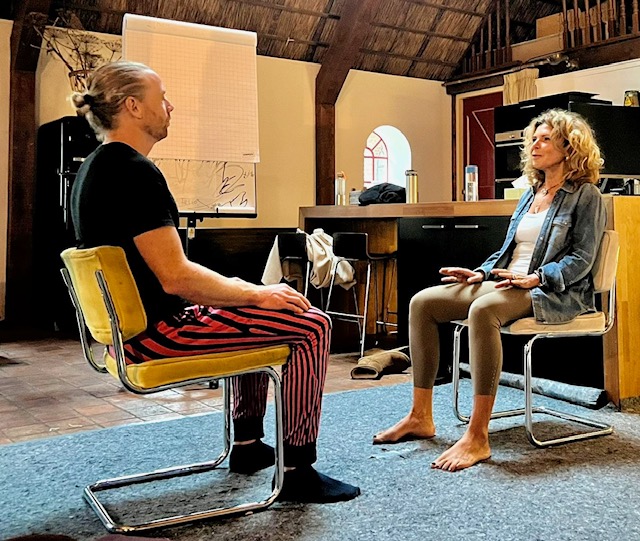
I already knew this, as a trauma-informed bodyworker, but it was only when I became a Somatic Experiencing practitioner that I fully understood it and learned how to work with it effectively, and how to rewrite the root of the body symptoms by working with the nervous system.
What Somatic experiencing does is self-awareness and practical tools to face and navigate life challenges.
SE (Somatic Experiencing) teaches simple but effective practices and tools we can do on our own to support our self-regulation; said that I always recommend seeing a therapist and receive the support and the right guidance to use them. And always remember that self-regulation is easier in presence of co-regulation.
The three key Somatic Experiencing tool for self-regulation:
1. BREATH: it is the highway to calm down and regulate the NS. Slow, extended exhalation is one of the most direct ways to influence the nervous system. When the exhale is longer than the inhale, the Vagus nerve is activated, which signals safety to the brain and allows the parasympathetic nervous system to come online.
Sit or stand in a comfortable position and let your spine be upright but relaxed: count six while you inhale, hold for two, and exhale for eight, you can feel the effect almost immediately. It gives the body time to sense that there is no immediate threat, which naturally reduces heart rate, muscle tension, and mental urgency.
2. “WOOO SOUND”: an incredible SE tool. It helps the body shift out of activation and into safety by stimulating the vagus nerve through voice and breath.
Sit it or stand in a comfortable position and let your spine be upright but relaxed. Take a slow, gentle breath in through the nose. Then, as you exhale, make a long, soft “wooooo” sound, like you are gently blowing across warm tea. The sound should come from deep in your belly and chest, not from the throat. Let the exhale be slow and extended and let the sound fade out naturally when the breath is finished.
You can feel how the vibration travels through your chest, throat, and face. This vibration sends a signal of safety to the nervous system and helps the body move from fight or flight into a more regulated state.
Repeat it three times in a row and then take a moment to observe how and what shifted in your system.
3. GROUNDING: Grounding means helping the body feel that it is here, now, and supported. When the nervous system is activated, a part of us is “up,” in the mind, in fear, in the future or the past. Grounding brings the energy back down into the body, into the legs, the feet, the sense of weight and in the here and now.
A very simple way to practice grounding is to bring your attention to your feet touching the floor, better to do it barefoot. Feel the connection with the ground, stretch your toes and move them as you want to grab the floor.
Self-regulation is a powerful beginning. Real transformation happens when you are met, seen, and guided in presence. If you would like more structure and support, you can download my free somatic regulation guide or connect with me to explore a deeper somatic journey together.